Bring your business into harmony.
We build custom AI agents and integrations that move work between your teams and systems—with clear permissions and human approval where it matters.
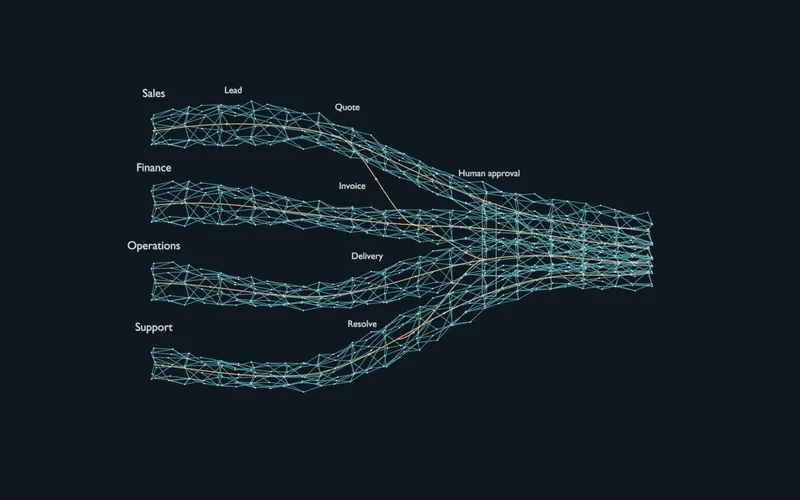 Move the pointer through the network to scatter it; move away to reconnect. Drag with a mouse to rotate. Keyboard: Space previews the effect, P pauses motion, arrow keys rotate, plus and minus zoom, and Home resets the view.
Showing the still illustration. The interactive view is unavailable.
Loading the interactive network…
Illustrative business processes, connected through custom AI.
From a signed agreement
to a clear handoff.
Illustrative workflow: sales to operations. An example of what we could build around a portfolio company’s systems and approval process.
Sales provides the agreement
A signed agreement and approved sales notes provide the starting point: what was promised, who is involved, and when work should begin.
The agent prepares a brief
Using permitted sources, the agent gathers requirements, flags missing information, and drafts the onboarding brief for review.
Your team reviews and approves
A designated person checks commitments, resolves open questions, and approves the brief before it moves into the operations workflow.
Operations receives the handoff
The approved brief moves to the agreed destination, giving the delivery team the requirements and responsibilities needed to start.
Other workflows to explore.
Illustrative possibilities to assess against your systems, data, and permissions.
- Document intake
- An agent could extract agreed fields and flag missing information from incoming documents. Your team reviews exceptions before information updates a business system.
- Internal knowledge
- Where source access and retrieval support it, an assistant could answer questions from approved documents with references for review. Your team decides which sources it may use.
- Service coordination
- An agent could summarize a request, gather context, and suggest the next action or responsible team. Ambiguous requests and actions beyond its permissions stay with your people.
Built around your workflow.
Scope the task
Map the workflow, review available systems and data, and agree the result to test for. Identify the information and decisions your team needs to provide.
Build and integrate
Develop custom agents or configure a platform, then connect the tools needed for the agreed task.
Test before release
Check routine requests, missing information, ambiguous instructions, and failed actions against agreed acceptance criteria.
Clear boundaries.
Ownership beyond launch.
Define what the agent can read, what it can change, and where it must stop for review. Agree how missing information and failed actions are handled. Available activity records depend on the connected systems and configuration.
Before handover, agree who runs the workflow, reviews changes, and handles issues. Documentation, training, monitoring, and ongoing support are defined in the engagement scope.
Good questions.
Clear answers.
Can we use our existing systems and AI platforms?
We develop custom agents and configure existing platforms. The approach depends on the systems, APIs, data access, and licensing available in your environment. Scoping establishes which connections are feasible and whether additional tools are needed.
What does our team need to provide?
Start with a workflow owner, representative examples, and a list of the systems involved. During scoping, agree who can authorize access, answer process questions, review test results, and approve release. The time needed from your team depends on the workflow.
Where will our data be processed?
Processing locations, retention, and any use of data for model training depend on the selected services and their configuration. These need to be reviewed against your requirements before data is connected. Identify the processing services, required information, and access boundaries during scoping.
What do we receive at handover?
The engagement defines deliverables, usage rights, source access, documentation, and any third-party licenses. It also establishes who administers the workflow after launch. Training, monitoring, maintenance, and support are agreed as part of the scope.
How do we start, and how long will it take?
Bring one task, the systems it touches, and the people involved. We discuss feasibility and define the scope before setting a timeline. Data readiness, integration access, testing, and your review process all affect delivery; there is no single duration for every implementation.
Can this work alongside an acquisition or cloud migration?
An AI workflow can be considered alongside integration planning, with its own scope and dependencies. Changes to systems, data access, and ownership need to be reflected in the design. We also deliver cloud-to-cloud migrations for M&A and cybersecurity services.
Is this the same as your AI-assisted security monitoring?
No. Custom agentic AI is a client-facing implementation service. AI-assisted monitoring is a capability within our managed cybersecurity work.
Which workflow is slowing your team down?
Tell us which task slows your team down, which systems it touches, and where someone needs to review the work. We’ll discuss the scope, access, and approval points an implementation would need.